Editor’s note: This report is part of a continuing series examining housing in the Lehigh Valley. An earlier installment explored eviction trends in the region.
BETHLEHEM, Pa. — Newly available apartments in the Lehigh Valley are drawing heavy competition, a trend that developers say is driven by intense demand amid a sustained shortage of housing.
DLP Capital, a private real estate investment firm, typically has a dozen or more applicants for its units at several large apartment properties across the region, according to John Przyuski, its director of real estate operations.
That’s even more competitive than what most people “think the market looks like,” Przyuski said.
The intense demand for apartments in the area reflects a deeper housing crunch in the region.
With more than 9,000 housing units needed today — and projections showing a shortfall of more than 54,000 by 2050 — newly available apartments are quickly snapped up and rents are climbing faster than the national average, pricing many residents out of the market.
DLP has operated in the Lehigh Valley for about two decades and maintains a significant footprint, with its conversion of the Hamilton at Grand Plaza in Center City Allentown and the opening of the Dream Boyd Theatre complex in Bethlehem.


Occupancy at its downtown Allentown residential conversion in late February was approaching 93% leased, which the company considers its “stabilization” point, Przyuski said.
“It’s a hot property,” he said. “We should be hitting our stabilization probably this time next month.”
Stabilized properties refer to those that have moved past an initial phase of development or renovation and are consistently generating reliable income and maintaining occupancy with little turnover.
Who’s renting?
The renter pool in Allentown spans all income levels and life stages, and DLP targets applicants “across the board,” Przyuski said.
“We have students from Lehigh and Moravian [universities]. We have professional athletes. We have retirees. We have brand new young professionals straight out of college.”
Leasing early in the coronavirus pandemic saw an influx of new residents from New York and Philadelphia, but that trend subsided as companies brought employees “back into three, four, sometimes even five days a week,” he said.
“The majority of our residents are Lehigh Valley workers.”
Przyuski said DLP uses standard income benchmarks to ensure tenants can sustainably afford rent — typically requiring residents earn at least three times their rent payment.
“If the rent is $2,000, we would expect their income to be $6,000 gross" pre-taxed income, he said.
“If the rent is $2,000, we would expect their income to be $6,000 gross."John Przyuski, DLP Capital
This week, a studio on the second floor was listed at $1,455, requiring an income of $4,365; a two-bed, two- bath on the sixth floor was $2,474, requiring nearly $7,500 gross income per month.
“That makes sure they can afford their rent, but also put stuff aside for retirement and afford their day-to-day operations,” Przyuski said.
He said the company discusses financial qualifications early in the leasing process to avoid putting prospective tenants in a difficult position.
“We don’t want them to fall in love with something they can’t afford,” he said.
DLP offers alternative options for applicants whose income does not meet the threshold. That sometimes leads them to a smaller unit or a different property within its portfolio, or to other landlords in the region.
“We don’t look at other properties as competition,” Przyuski said. “If we don’t have something that works for them, we’ll try to help them find something that does.”
The objective is long-term stability, not turnover, he said.
“Our goal is not just that they can afford the apartment they’re in, [but that] they can afford the next step in their life.”

Economic realities
Przyuski also acknowledged “it’s not cheap” to move into an apartment, a process that can bring significant upfront costs.
“It’s not just your first month’s rent,” he said. “There are security deposits, pet fees, pet rent. We try to keep that as soft as possible, but it’s still a reality of the market.”
Beyond tenant screening and leasing practices, DLP leaders say cost pressures extend well beyond what renters see each month.
The math behind delivering new apartments has become increasingly difficult in recent years, according to Joshua Jakubiec, director of marketing and strategy for DLP Capital.
Rising construction costs, higher interest rates and more expensive financing have narrowed the range of projects that pencil out, particularly for lower-rent units.
Underlying development costs often prevent builders from adding smaller or more affordable apartments to the market without subsidy or public support, despite great demand for them, Jakubiec said.
Those economic realities are not unique to DLP, he said. They are part of a broader market dynamic that shapes what gets built, and at what price point.
Affordable housing
Building affordable housing developments is “very much the same” as building market-rate projects, according to Jonathan Strauss, a partner at Cortex Residential.
“The math has to work” for developers and their financial backers, Strauss said.
But the math on affordable housing means “smaller figures,” driving a need to minimize large operating expenses such as common areas, he said.
And it often includes public funding with strict compliance mechanisms, he said.
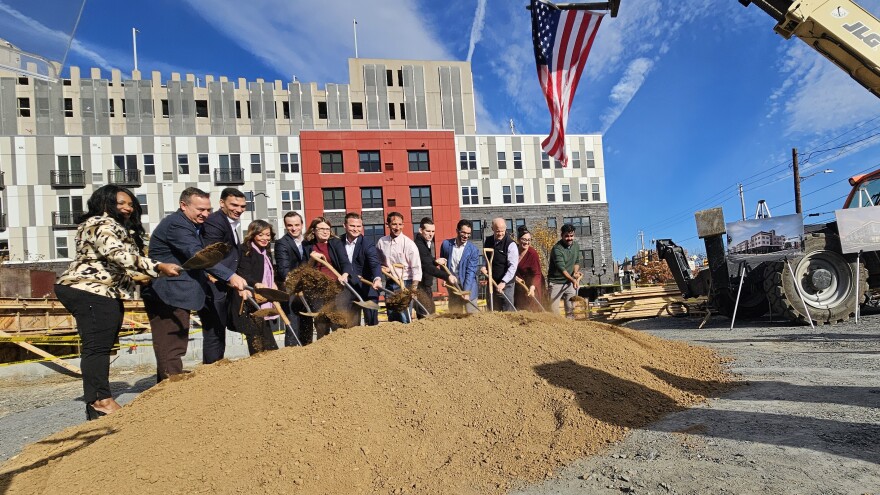
Cortex is working to build a housing complex for people with low-to-moderate incomes in downtown Allentown. The project is expected to cost about $17 million; almost all of that funding is coming from public sources.
“It’s a very simple supply-demand curve and right now we have insatiable demand for very little supply.”Jonathan Strauss, Cortex Residential partner
The developer secured about $14 million from the Pennsylvania Housing Finance Agency, while Allentown contributed $2 million from its coronavirus pandemic-relief funds to get the project up and running.
That money will fund 38 units across a three-story, 44,000-square-foot facility at the northwest corner of South Eighth and Walnut streets.

Four units will be reserved for people with incomes at or below 20% of the area’s median income; the other 34 units will house families whose incomes are below 60% AMI.
A single person earning about $42,000 or less per year would qualify for an apartment in the Cortex complex, and they’d pay no more than $1,130 for a one-bedroom apartment, based on PHFA affordability standards, Strauss said.
PHFA-funded developers must prove their residents meet income thresholds through annual inspections and compliance checks.
The state agency’s funding also comes with a 30- or 40-year deed restriction to ensure long-term affordability.
“It's our goal to always build affordable (housing), but solving the housing issue is going to come from building supply."Jonathan Strauss, Cortex Residential partner
City officials approved Cortex’s initial plans to build a four-floor complex with 52 one- and two-bedroom units, but its size and scale of the final design were determined by the amount of tax credits from the PHFA.
“I would have loved to construct an 80-unit building at Walnut Square, but there’s not enough subsidy,” Strauss said. “The lack of subsidy is what restricted us from being able to build more.”
The lack of available subsidies also limits the overall number of affordable housing projects throughout the state.
But Strauss said developers must focus on “workforce housing,” or homes built for people who make 100-140% of the area’s median income — about $84,260 to $117,964 (based on the area's median household income).
“If we want to solve the affordable housing crisis, we’ve got to focus on the middle of the workforce to alleviate pressure,” Strauss said.
“It’s a very simple supply-demand curve and right now we have insatiable demand for very little supply.”
The current workforce is made up of teachers and nurses, cops and firefighters, chefs and delivery drivers — “the people that provide goods and services to the rest of us,” Strauss said.
But with wages mostly stagnant and inflation “ripping,” they’re often priced out of market-rate units and forced to look for cheaper options, adding even more competition for the few available at those rates, according to Strauss.
Cortex owns and operates about 2,000 affordable units across Pennsylvania. Strauss said the company plans to continue that mission while also looking for opportunities to build “mixed-income” housing, where people of all incomes can live together.
“It's our goal to always build affordable [housing], but solving the housing issue is going to come from building supply,” Strauss said.
“The more density that we can build — coupled with the affordable components — the more effective we’ll be overall.”
Pressure unlikely to ease quickly
Housing data suggests the dynamics playing out in the Lehigh Valley are part of a broader pattern seen in many midsize metros across the country, according to Orphe Divounguy, a senior economist with the research team at real estate marketplace company Zillow.
Like regional planners, he identified a lack of housing inventory as the Lehigh Valley’s “biggest issue.”
“There’s just not a lot of housing inventory… and so that’s going to continue to keep pressure on rents,” Divounguy said.
Many parts of the country have seen a surge in apartment construction that helped slow rent growth in recent years.
But the Lehigh Valley has not experienced that same level of supply expansion, and many apartments under construction are designated at market rate.
“In the Allentown region, rent growth is higher,” he said. “Rents are increasing faster than in many markets across the country.”

What could change the housing deficit in places like the Lehigh Valley? Researchers increasingly are focused on “middle housing” – smaller-scale options such as townhomes, duplexes and accessory dwelling units that fall between single-family homes and large apartment complexes.
“When we talk about the middle, we really talk about these middle-scale housing options that are more affordable,” Divounguy said. “So duplexes, townhomes, bungalow courts, ADUs, to basically find ways to get more people into homes that are affordable.”
But those types of homes are often difficult to build in places where zoning codes restrict density, require large lot sizes or mandate extensive parking — regulations that can make lower-cost housing financially infeasible.
In its 2025 annual report, Lehigh Valley Planning Commission listed a total of 5,891 residential units proposed across the area.
Apartments made up the bulk of them, at 3,450 units, followed by single-family detached homes (988 units) and rowhouses (952 units).
Twins accounted for 387 units, while condominiums (78 units) and manufactured homes (36 units) represented a smaller share.
But using proposed units alone can overstate the near-term housing supply, because not all proposals get approved.
The region is more than 9,100 housing units short of what it needs for its residents, as of early 2026, according to the LVPC.
That number could climb over 54,000 by 2050 if population growth follows current projections.
Addressing that shortage often requires policy changes at the local level, Divounguy said, particularly around zoning and land-use rules that shape what kinds of housing can be built.
“The long-term solution to this problem is to allow builders to build more housing,” he said.
“Fixing the problem for the next few years is absolutely going to require policymakers to look at restrictions to building residential housing, fixing zoning laws in the local area.”
The imbalance between demand and supply is showing up in another indicator in the data: incentives offered by landlords.
Nationally, property owners have increasingly offered concessions — such as free parking or a month of free rent — as new buildings opened and competition increased.
That trend has been far less common locally, Divounguy said.
“When you look at the country and the increase in inventory that took place nationwide, more and more landlords were saying, ‘Hey, we’re going to give you free rent, a one month free rent or free parking,’” Divounguy said.
“But in the Lehigh Valley area, the share of rentals with concessions is really low… and that also speaks to the fact that there just isn’t as much competition amongst landlords, simply because there isn’t that much housing inventory.”

The leap to homeownership
Even as rents rise, the gap between renting and owning in the region is not always as wide as some people might expect, Divounguy said.
In many cases, the monthly cost of a mortgage payment can be similar to local rents.
“When you compare the cost of renting a unit in the Lehigh Valley to the typical mortgage payment for a new buyer, the gap is not very large,” he said.
“Most median-income households in the area could potentially afford to make the move into the for-sale market.”
But the biggest barriers often come before a buyer ever reaches the monthly payment.
“That potentially tells me that people struggle with the hurdles to homeownership,” he said, pointing to down payments, closing costs, credit history and debt-to-income ratios as common obstacles.
At the same time, the region has seen especially sharp growth in home values over the past several years, a trend that has made entering the market even harder for first-time buyers.
“Home values in the Lehigh Valley are up roughly 57 percent when compared to before the pandemic,” Divounguy said.
“That appreciation in that market is much higher than what we’ve seen nationwide.”
Although price growth has slowed more recently, it has not reversed.
Over the past year, home values in the region increased 2.8% year-over-year, compared with roughly flat growth nationally.
That combination of strong price appreciation and limited new supply means affordability pressures could persist for years without significant changes in housing production.
“The long-term solution to this problem is to allow builders to build more housing,” Divounguy said.
“The best way, the most proven way, to improve housing affordability is still very much supply, supply, supply.”

- Think about financing as early as possible. Financing first.
- Connect with a great agent. “You cannot go into a place just looking at data and thinking you’re going to completely understand it all. You have to work with a great local agent who does this day in and day out and really understands the local market.”
- Take advantage of down payment assistance (DPA) or homebuyer assistance programs, including grants, forgivable loans and deferred-payment loans.
- The First Front Door (FFD) program, which can help homebuyers with closing costs and down payment.
- The Employer Assisted Housing (EAH) Initiative
- HOMEstead Downpayment and Closing Cost Assistance Loan
- Keystone Advantage Assistance Loan Program
- Good Neighbor Next Door Program
- The Keystone Forgivable in Ten Years Loan Program (K-FIT)
REGISTER FREE: As part of our ongoing housing series, we’re inviting readers to join us for a Community Conversation on the challenges and opportunities shaping housing in the Lehigh Valley.
The discussion will take place March 26 at 6 p.m. at the Univest Public Media Center and will bring together local leaders and experts for a candid conversation about affordability, development, and what comes next for the region.