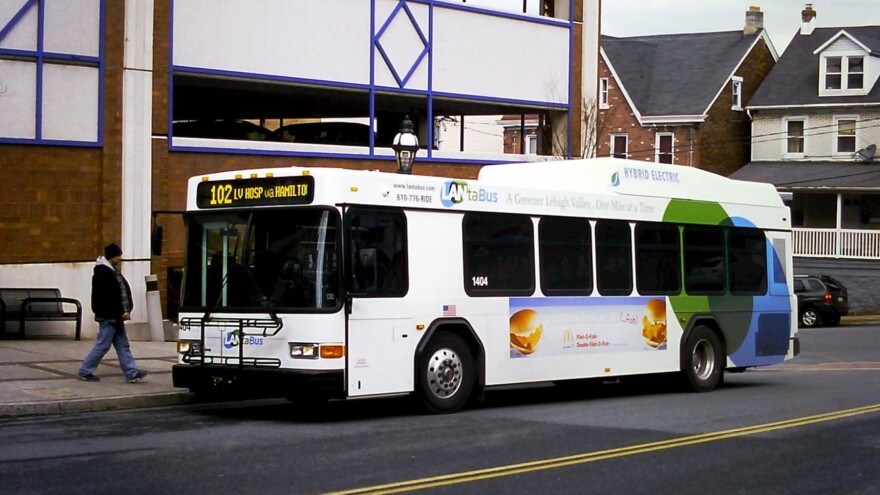
ALLENTOWN, Pa. — LANTA will cut service about 5% on its fixed-route bus system and is proposing a 20% single-ride fare increase as the Lehigh Valley transit agency looks to Harrisburg for a long-term funding solution.
The service cuts eliminate at least some trips on 13 routes and take effect Jan. 26, said Owen O’Neil, executive director of the Lehigh and Northampton Transportation Authority.
Proposed fare increases would take effect in March, pending LANTA board approval.
A public meeting on the proposed increases is scheduled for 6 p.m. Jan. 14, at the LANTA Rider Resource Center, 60 W. Broad St., Bethlehem.
“It’s a question of reducing certain trips at certain times of the day or certain days of the week. We looked at our lowest productivity trips.”Owen O'Neil, LANTA executive director
The reduced service and elimination of trips — not nearly as drastic as feared months ago — are weighted more toward evening and weekend runs to minimize disruptions, O’Neil said.
Specific routes being affected are on the LANTA website.
“One thing we really tried to focus on is all of the routes are staying the same,” O'Neil said of the trip reductions. “There are no routes going away; the lines on the maps are staying the same.
“It’s a question of reducing certain trips at certain times of the day or certain days of the week. We looked at our lowest productivity trips.”
While the service cuts are tied to Pennsylvania’s long-running public transit funding dilemma, the proposed fare hikes are not.
Under state transportation law, transit agencies are required to show they’re increasing the amount of revenue obtained from passenger fares, O’Neil said.
LANTA had considered raising rates around 2020, but when the coronavirus pandemic hit, the board decided to keep rates stable, he said.
New fare structure
Under the proposal being considered now by the board, single rides will go from $2 to $2.50 and the 31-day pass will rise from $60 to $70, or about 17%.
The base cash fare of $2 hasn’t increased since 2009 and LANTA’s monthly pass has remained unchanged since 2014, O’Neil said.
The new fares proposal would be considered by the LANTA board in February and implemented in March, O’Neil said.
Under the changes, LANTA would eliminate transfers issued on buses and replace them with a three-hour pass that would cost $2.50 — the same as a single ride.
It would allow unlimited rides from the time of activation.
Details of the proposed fare structure and trips being eliminated on specific routes can be found on the LANTA website.
As for LANTA service, the agency was able to use COVID relief money to add service with the Green Line and Blue Line of its enhanced bus service initiative nearly three years ago.
But those resources now are gone and lawmakers and the governor’s office have been unable to come to terms on a dedicated mechanism to reliably fund Pennsylvania public transit.
State funding dilemma
LANTA is far from alone.
Public transit organizations entered the year facing similar shortfalls, and Gov. Josh Shapiro proposed shifting $292 million of income tax revenue to help plug their budget gaps as part of his 2025-26 budget.
But the proposal was dead on arrival in the Republican-controlled state Senate.
The state's biggest — and most expensive — transit authorities are based in the Democratic bastions of Philadelphia and Pittsburgh. Many Republicans openly lawmakers balked at sending millions of dollars to agencies that won't directly serve their constituents.
When lawmakers finally crafted a $50.1 billion budget months behind schedule, it didn't include long-term funding for transit.
Shapiro made some funds available to stave off deep cuts — LANTA received a $26.5 million operating grant — but the service cuts and rate hikes were unavoidable, O'Neil said.
“We did receive some bump and some stabilization funds from PennDOT — and that allowed us to bridge some gaps and not do cuts immediately,” he said. “These are short-term funds.
“As we look ahead, we don’t expect that level of resources being available so we’re starting to make the adjustments now to make sure that over the long term our service level is sustainable.”
Other cuts not anticipated
Besides the trip reductions, O’Neil said, he does not anticipate having to defer maintenance on the fleet or cut jobs through the rest of the fiscal year that goes through the end of June.
“We are not planning layoffs. Because these are gradual, any type of changes in staffing can be done through attrition.”Owen O'Neil, LANTA executive director
“We are not planning layoffs,” he said. “Because these are gradual, any type of changes in staffing can be done through attrition.”
In November, LANTA held two public meetings on the service reductions that take effect near the end of January.
“Reducing service is never something that we want to do or that riders like to hear, but we did try to make sure that we were focusing on the lowest-performing trips and also making sure we were maintaining service so people can still get to places and to jobs without eliminating full routes," O'Neil said.
“That’s not something that anyone ever wants to hear about. I think people are understanding and seeing we’re trying to maintain routes and connectivity.
"We did get some good suggestions from public meetings and we were able to incorporate some of that into the final plan going into effect on January 26th.”
Staff writer Tom Shortell contributed to this report.