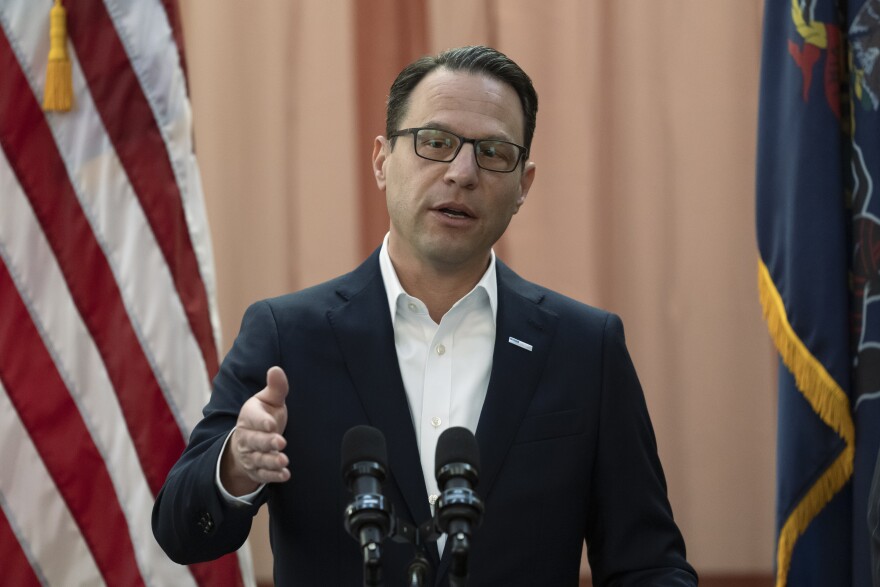
HARRISBURG, Pa. — Lehigh Valley elected officials reacted with admiration and disgust to Gov. Josh Shapiro's $53.2 billion budget proposal Tuesday afternoon.
They fell along party lines in reacting to the governor's pitch to raise the minimum wage, legalize marijuana, establish guidelines for data centers and invest $1 billion in public housing and other critical infrastructure.
Shapiro, who is seeking re-election this year and is being viewed as a potential presidential candidate in 2028, hit on familiar themes of commonsense measures to create jobs, ease regulations and build safer communities.
He also took time in a 90-minute address to celebrate major achievements from the past year, including news that Eli Lilly has agreed to invest $3.5 billion to create a new pharmaceutical manufacturing center in Upper Macungie Township.
"We're solving problems and getting stuff done to improve people's lives, and Pennsylvania is on the rise," Shapiro said, pointing to reports that the commonwealth is the only state in the Northeast with a growing economy.
"Today's performance was not a serious plan to govern but rather a campaign speech dressed up as a budget."State Sen. Jarrett Coleman, R-Lehigh/Bucks
But Shapiro's 2026-27 proposal also reintroduced plans to regulate skill games — slot machine-like gambling devices common in social halls and fraternal clubs — and legalize weed.
While they would raise revenue that would better balance the budget, those both proved to be breaking points in the General Assembly last year.
As a result, the state endured a months-long budget impasse that led to funding crises for nonprofits, school districts and county governments.
Sen. Jarrett Coleman, R-Bucks/Lehigh, chided Shapiro for falling back on those proposals and for swipes at Republicans that were part of his address.
Shapiro called out Senate Republicans for rejecting past efforts to raise the minimum wage, which Shapiro called unnecessary political theater.
"Today's performance was not a serious plan to govern but rather a campaign speech dressed up as a budget," Coleman said.
Data centers
Developers and tech companies are increasingly proposing plans to construct giant data centers capable to processing massive amounts information while also sucking up amounts of power and water.
Pennsylvania's zoning and utility laws currently treat the projects as more traditional ones, which could place enormous strains on communities' energy and water supplies.
South Whitehall and Upper Macungie townships both have seen proposals for massive warehouse facilities in recent months.

In his address, Shapiro outlined the Governor's Responsible Infrastructure Development, or GRID, standards.
The plan would require that data centers either generate their own power or pay for new power generation to prevent fees from spiking electric costs for residents or small businesses.
The data centers also would need to agree to unspecified transparency standards and to train and hire local Pennsylvanians at their facilities.
Lastly, tech companies would need to meet environmental protection standards, particularly water conservation efforts, Shapiro said.
In return, tech firms and developers would be eligible for permitting perks and tax credits, he said.
"We can play a leading role in winning the battle for AI supremacy, but we have to do it in a way that puts the good people of Pennsylvania first," Shapiro said.
The plan has similarities with a package of bills introduced last month by state Sen. Lisa Boscola, D-Lehigh/Northampton.
Boscola's package would create separate electric rates for residential customers and small businesses to shield them from surging power costs.
It also would empower the PUC to regulate when data centers can go online to ensure that the electrical grid can support data centers without causing rolling blackouts.
The GRID proposal, she said, would position the state to be at the forefront of the AI field, encourage responsible development and protect residents' wallets.
Unlike during many of the governor's talking points, many Republicans stood and applauded the GRID proposal, she said.
"I appreciate that the governor elevated this issue," Boscola said. "I don't think a lot of my colleagues were thinking this way when it comes to energy."
Public housing
Shapiro proposed borrowing $1 billion in bonds to create a new Critical Infrastructure Fund that would address public housing among other needs.
As does the Lehigh Valley, Pennsylvania faces a growing housing shortage.
The state will be short 185,000 units by 2035 if no action is taken, and half of the units on the market are more than 50 years old, making them expensive to maintain, Shapiro said.
He also proposed reworking the state's zoning and planning laws to better streamline development.
He called for creating more mixed-use structures on main streets and commercial corridors to create more transit-friendly communities.
"Rather than tinker with this, let's go big and make a real impact," Shapiro said. "We need hundreds of thousands of new homes. This is how we build them."
"It is a solution that matches the scale of the crisis. We should be pursuing them simultaneously."Lehigh County Executive Josh Siegel
Lehigh County Executive Josh Siegel won his new office on a campaign centered around the need for mixed-use public housing.
He has proposed partnering with other local governments to borrow $100 million to create apartment complexes that would include affordable units in an effort to quickly get thousands of housing units on the market.
Allentown Mayor Matt Tuerk has offered support on such a proposal.
Siegel, a former state House representative who attended the address as a guest of House Speaker Joanna McClinton, D-Philadelphia, called Shapiro's proposal vindication.
Seeing the governor's plan match so closely to his own meant that he's on the right track, Siegel said.
He said he believed the two plans could co-exist and potentially let the Lehigh Valley more quickly address its own housing shortage.
"It is a solution that matches the scale of the crisis," Siegel said. "We should be pursuing them simultaneously."
State Rep. Mike Schlossberg, D-Lehigh, the House majority whip, expressed hope that even fiscal hawks could get behind the bonding plan.
Earlier in his term, Shapiro persuaded lawmakers to borrow $500 million to fund his economic development initiative, and that's paid dividends by attracting companies and creating jobs.

Road blocks
This year's $53.2 billion proposal is larger than the $51.4 billion plan Shapiro floated a year ago. Republicans quickly denounced both plans as untenable.
At the heart of the problem is the state's structural deficit. The ultimate 2025-26 budget — a $50.1 billion spending plan that arrived 135 days late — relied on reserve funds to plug a $3.7 billion funding gap.
Shapiro wanted to diminish that gap by legalizing — and taxing — marijuana and regulating skill games.
But lawmakers were unable to reach a consensus on how much to tax skill games, and marijuana negotiations made little progress.
This year, Shapiro is returning to those proposals to minimize the funding gap.
"We're all crazy in the legislative process. The thing is, sometimes crazy works."State Rep. Mike Schlossberg, D-Lehigh
When a reporter asked whether proposing the same idea met the definition of insanity, Schlossberg expressed optimism.
"We're all crazy in the legislative process," he said. "The thing is, sometimes crazy works."
Schlossberg said the governor appeared to be taking a more hands-on approach to negotiations.
During the address, Shapiro said he'd invited both parties' leadership teams in the House and Senate to a joint meeting to kick off the process and that all sides had accepted.
During the budget standoff last year, many frustrated voters approached Schlossberg asking why state leaders weren't pushing harder to bridge the divide.
"The governor clearly heard that question, too," Schlossberg said.
Fatally flawed
Other lawmakers were more skeptical.
Coleman needed little time to reject the plan as fatally flawed. Even with the new revenue, the state would be burning through its reserves, he said.
Shapiro argued during his address that his plan would eliminate the need to raise taxes for at least five years.
"The point of no return was last year," Coleman said. "Last year's budget was a fiscal calamity and has set Pennsylvanians up to go to the slaughter house.
"This can't even be called a budget."
Coleman said he opposes any taxes on skill games, while some Republican senators reportedly supported taxing them at a 35% rate.
Shapiro has proposed taxing skill game operators at 52%, which his administrations said would raise $2 billion in revenue. By comparison, casinos are taxed 55% on electronic games.
Boscola and Coleman both were doubtful a deal on marijuana, could be brokered, especially in an election year.
While many of the surrounding states have made it legal to buy weed at approved dispensaries, Boscola said she believed lawmakers would be too reticent to address the tradeoffs that would come with legal marijuana.
"I wish that I'm wrong, but I don't see it happening," she said.
Coleman agreed.
"I don't see the Lehigh Valley or Pennsylvania becoming the next ganja grove of the United States," he said.