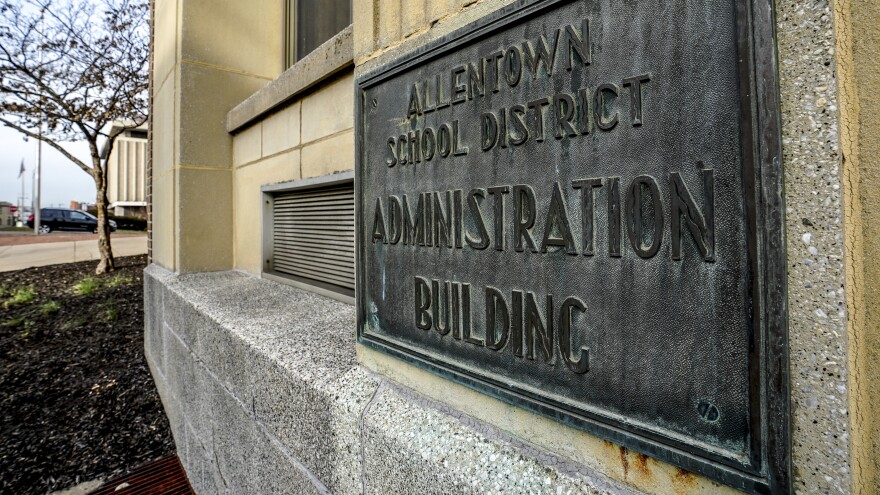
ALLENTOWN, Pa. — In the inaugural episode of her new podcast, Allentown School District Superintendent Carol Birks hosted a panel on artificial intelligence.
“I’m really proud of the ways we have been implementing AI throughout the district,” Birks said in the first episode of the quarterly podcast, which was streamed Thursday.
It’s called “Lighting the Way with Dr. Carol D. Birks,” a nod to the district’s strategic plan, "Lighting the Way: A Blueprint for Innovation and Excellence 2030."
In the hour-long episode, Jayden Santos, a senior at ASD’s Bridgeview Academy, spoke about his experiences at the new theme-based high school, which has career pathways in artificial intelligence, computer science and health care.
The high school has a new media lab with a full production studio, Santos said.
He recently used the space to record a public service announcement about gun violence in schools for his government class, he said.
“It was so much more engaging than just writing a paper,” said Santos, who serves on the superintendent’s student advisory committee.
Santos also is a member of the high school’s technology team – an initiative that is part of Bridgeview Academy’s participation in the Verizon Innovative Learning Schools (VILS) program.
Through the program, students at Bridgeview Academy and the district’s four middle schools received iPads equipped with keyboards and 24/7 internet access to both use in class and take home.
The goal of the VILS program is to increase digital equity at secondary schools by helping students access technology and training teachers on how to effectively use it in the classroom.
Santos and other tech team students are receiving advanced training on tools that will be used in their classrooms.
Additionally, the tech team students are learning how to use 3D printers and other tools in the high school’s new makerspace, he said. Soon they will train teachers and other students on how to use the tools.
Through the VILS program, Bridgeview Academy also will have a pilot program to teach students about digital identity and the best uses of AI, Santos said.
“AI has gone from the thing that we don’t talk about in classes or in schools to being something that we use in many of our classes,” Santos said.

Teachers integrate AI into learning
Santos said his English teacher Charles Schmied has become “a pro at using AI.”
Schmied wrote a classroom behavior app that runs during class to help students stay aware of their behavior and whether it is appropriate, Santos said. Students and their families can then review the behavior reports.
Schmied, who is a teacher tech leader at Bridgeview Academy, also used AI to build a reading tool that helps students annotate texts, Santos said.
Santos said his teachers have ethical discussions about AI use with students, too.
His U.S. government teacher Shannon Salter was teaching her class how to write better conclusions for their presentations when she caught some students using AI to do their work.
“Instead of giving them zeros and not accepting the work, Ms. Salter showed us how AI didn’t actually do a good job at replacing us,” Santos said.
Salter told the class that the AI-written conclusions weren’t as good as the student-written ones, which scored higher grades, Santos said.
“By talking about it instead of banning the topic in class, we’re learning more about when and when not to use AI to help us,” Santos said.
Risks, industry impacts of AI
Brennan Pursell, a DeSales University business professor and director of the Center for Data Analytics and Applied AI, also spoke on the panel about the risks of AI and misconceptions about the technology.
Pursell has helped the district expand its AI learning by coordinating the Allentown Summer Artificial Intelligence Institute, a partnership program that teaches ASD high schoolers about data analytics.
Pursell said AI is a general purpose technology that can be used in many jobs across the economy.
It won’t change some jobs, such as those in the trades that require manual labor, he said. But it will change the way businesses are run, from accounting processes to marketing practices.
“This technology will affect the way we work in this country,” Pursell said.
“This technology will affect the way we work in this country."Brennan Pursell, DeSales University business professor
He estimated about 80% of jobs will be impacted by AI in some way.
Pursell also warned that AI can be toxic and addictive. He pointed to AI chatbots that can distort reality for vulnerable people, such as children and those who have mental health challenges.
“I don’t demonize it, but we have to identify the risks.”
State Sen. Nick Miller, D-Lehigh/Northampton, recently co-sponsored a bill about AI safety.
In the bill co-sponsored by the former Allentown School Board director, AI technology companies would be required to fulfill certain disclosures and safeguards to protect children and those at risk of harming themselves or others.
But President Donald Trump on Thursday signed an executive order to ban states from regulating AI, arguing in favor of a “national framework.”
Meanwhile, tech experts say the executive order is likely to be challenged in court, according to reporting from NPR.
Safe AI tools for students
In its use of artificial intelligence, ASD has chosen tools that prioritize safety, according to Kyle Kauffman, director of innovation and instructional technology.
The district uses the AI assistant Google Gemini, which has a guided learning mode that prompts students with questions in order to explore a topic.
“The reason we chose it partially is because it’s built with safety in mind, it’s built with education in mind,” Kauffman said.
“We’re very serious about our chatbots and our models that we’re using.”
“We’re very serious about our chatbots and our models that we’re using.”Kyle Kauffman, director of innovation and instructional technology
ASD also uses Google Notebook LM, a research tool that can analyze sources and act as a thinking partner, among other Google tools.
Students use design tools, such as Canva and Adobe Express, too.
Additionally, ASD uses different AI tools at different grade levels, Kauffman said.
For secondary math, students use ALEKS, which personalizes math learning based on the skills students need to master.
In sixth-grade English classes, Coursemojo acts as an assistant teacher, personalizing and differentiating learning with instant feedback.
Kauffman said it’s essential students learn about AI and how to learn content using it.
“AI is radically changing the work our students do when they leave us and we need to prepare them better,” he said.
The topic and release date of the next episode of “Lighting the Way with Dr. Carol D. Birks” has not yet been released.