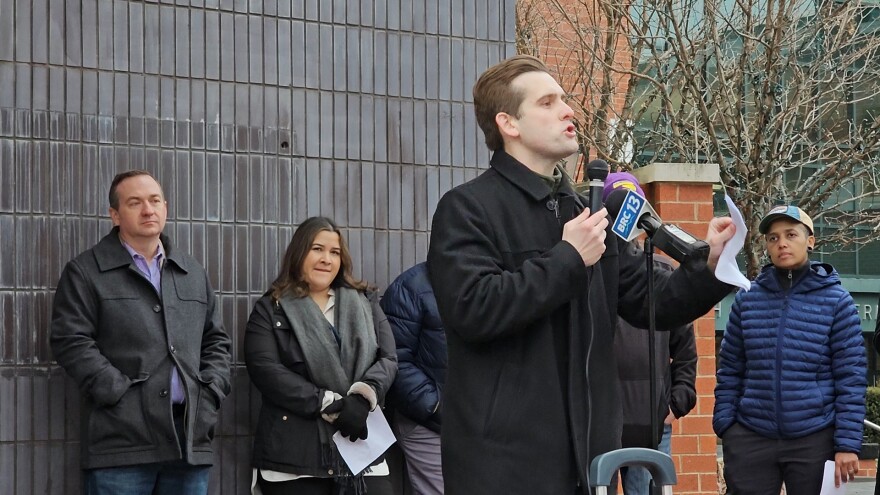
BETHLEHEM, Pa. — As the dust settles on his landslide victory last month, Lehigh County Executive-elect Josh Siegel is preparing to have his $100 million housing proposal ready to go out of the gate.
Over the past decade in Lehigh Valley politics, the 31-year-old Democrat hasn't been afraid to lay out ambitious goals.
On the campaign trail this year, he criticized opponent Roger MacLean as a man with no ideas while he floated proposals for regional police and fire service, and creating an election task force that will help voters cure flawed mail-in ballots.
But his top priority, he said, may also be the most expensive. Siegel said his opening months in office will focus on launching a new housing program capable of putting a dent in the region's housing shortage.
"I was elected overwhelmingly with a mandate," Siegel told LehighValleyNews.com. "I think I was elected in part on the boldness of my platform, and I am going to deliver."
Addressing a shortage
The Lehigh Valley's population boom had already created a tight housing market before the COVID-19 pandemic struck. Now, the Lehigh Valley Planning Commission reports the region has 9,000 fewer housing units than it needs. The challenge will only get worse in the years ahead as the region's population is expected to keep growing.
The housing crisis is particularly acute with households earning more than $99,000, according to the commission. With wealthy families unable to move up into more expensive units, the Lehigh Valley has experienced a housing logjam that's prevented other households from upgrading their living quarters and frozen others out of the market completely, according to an LVPC study.
While county government has had limited dealings in housing in the past, Siegel said the current crunch demands that local leaders take decisive action. His plan would see Lehigh County partner with other communities to pool their resources and potentially build up to 1,500 housing units in the region.
Under his plan, the county would either form a new entity or tap the Lehigh County Housing Authority to oversee a public-private partnership.
The government would take out a bond that would finance loans to developers. Those developers would use that money to construct high-density apartments in walkable neighborhoods, Siegel said. Once the housing is completed and tenants are in place, the government would buy the apartment complexes back.
Developers should be attracted to the project, Siegel said, because the county can loan developers money at significantly lower interest than what's typically available in the private sector.
At the same time, the interest the developers would pay on the loans will help defray the government's debt on the bonds, said Siegel. The rents and interest fees would help the county pay off the debt and allow the county to take out another bond to build more housing.
The model is based off a Montgomery County, Maryland, program that's drawn national attention.
While most of the resulting apartments would be rented at market rate, about a third of the units would be available to households earning between 60% and 50% of the area median income, or AMI. For a family of four in the Lehigh Valley, a 60% AMI would amount to $60,120 in 2025, according to the U.S. Department of Housing and Urban Development.
Siegel acknowledged his plan wouldn't address the shortage of high-end housing the planning commission believes is contributing to the problem. However, focusing the county's attention on high-end housing would leave too many low-income families waiting for a market correction, he said.
"The Planning Commission is not wrong. It’s just a slower process. It doesn’t deliver results immediately," Siegel said
Seeking support
To make the project work, Siegel anticipated local government would need a $100 million bond. After consulting with Lehigh County officials, Siegel said the county could take on up to $60 million of debt, though he hopes it won't need to max out on its borrowing capability. He would not push to raise taxes to move the project forward, he added.
Instead, he's looking to partner with other local governments.
At this early stage, Siegel said he's approached Allentown Mayor Tuerk and Northampton County Executive-elect Tara Zrinski to gage their interests and how much their communities could contribute to the project. And while outside support will be necessary if they're going to get to the $100 million target, Siegel said the county won't be shirking its fair share.
"I think we have to show we have skin in the game. We should be contributing a considerable portion," Siegel said.
In an interview Friday, Tuerk praised Siegel's strategy and leadership on the issue. Housing prices have been a problem across the country, and Allentown is looking for partners to address the issue, he said.
On Wednesday, Allentown City Council approved a new 0.5% tax increase on deed transfers that would fund housing initiatives. Some of that money may go toward defraying Lehigh County's debt service for this housing project, Tuerk said. While some of the construction may take place outside the city limits, the new units will help ease the costs of rent in Allentown.
"We will fund it to whatever extent that we can, knowing that parts of that will be in the city," Tuerk said. "We know that we have to take a regional approach."
A real test, Tuerk said, will be how many suburban communities get involved. As more and more people move to the region, the Lehigh Valley's cities have been on the front lines of the housing crisis. But it's the suburbs that have the space to develop.
"It shouldn't all be on Bethlehem's and Allentown's shoulders," Tuerk said.
Transition team
Siegel announced a 30-member transition team to help ready his administration for the goals he's laid out.
It includes a Housing Subcommittee made up Jonathan Strouss, co-founder of Cortex Residential; Abby Goldfarb, executive director of the Lehigh Conference of Churches; Robert DiLorenzo, director of planning and construction at City Center Group; Phil Malitsch, director of land development for Tuskes Homes; and Asher Schiavone, director of government affairs for Greater Lehigh Valley Realtors.
The transition team also includes a "Local Resilience and Response Team to Trump Administration" subcommittee.
Chaired by Lehigh County Commissioner Jon Irons, the group will be tasked with planning for how to respond if the Trump administration attempts to interfere with local elections or deploy U.S. Immigration and Customs Enforcement (ICE) into the region en masse as it has in cities like Chicago.
Siegel made his opposition to the Trump administration a key element of his campaign and went out of his way to tie MacLean, his Republican opponent and former Allentown police chief, to the commander-in-chief.
That language, Siegel said, wasn't just campaign rhetoric.
"The election was a referendum on the bulls***, on what’s been happening in D.C. We have no interest in allowing the Trump administration run roughshod or harass our people," Siegel said.