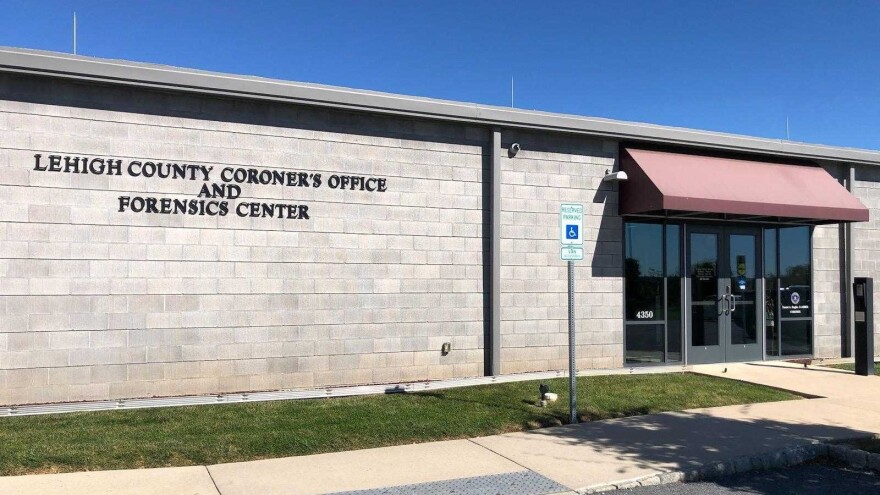
SOUTH WHITEHALL TWP., Pa. — In response to a growing number of area deaths showing signs of respiratory illness, Lehigh County Coroner Dan Buglio said Wednesday his office has expanded post-mortem testing for viruses such as influenza, COVID-19 and RSV.
Buglio said the decision is driven by what investigators are increasingly encountering during death investigations, particularly in private residences.
“It’s not uncommon we do a COVID test. But now we’re putting kits together for the deputies if they go to a house.”Lehigh County Coroner Dan Buglio
“What happened and the reason why I’m doing this is because of the high numbers,” Buglio said.
“We’re going through cases and we’ll see a lot of tissues around the decedent and signs they had a respiratory illness, or [the] family says we haven’t seen them in a few days but maybe they had COVID or the flu but we’re not sure.”
While COVID testing has long been part of some investigations, Buglio said the office now is formalizing and expanding its approach.
The coroner’s office has assembled respiratory testing kits that deputies carry with them when responding to deaths in homes.
“It’s not uncommon we do a COVID test,” Buglio said. “But now we’re putting kits together for the deputies if they go to a house.”
Focus on unattended deaths in homes
Buglio emphasized the approach is case by case, with the primary focus on unattended deaths occurring outside of medical facilities.
In hospitals and nursing homes, testing typically already is documented.
“But we can’t sign a death certificate if we don’t know for sure" what the cause is.Lehigh County Coroner Dan Buglio
“Nursing homes test for this," he said. "If we see that it’s being done in a nursing facility we’ll pull those records and we’ll do that.”
If someone recently saw a physician, the coroner’s office first tries to get those medical records before conducting additional testing.
“If we know a person went to a doctor the day before, we’ll pull those records and see if that result is back and if needed do another swab,” Buglio said.
In home deaths, however, uncertainty can delay certification without additional testing, he said.
“In homes, people maybe hear the hospitals are crowded and if they have underlying medical history on top of that it might deter them from seeking treatment.
“But we can’t sign a death certificate if we don’t know for sure" what the cause is.
Reporting results to health agencies
Buglio said results from the enhanced testing are shared with public health officials to aid surveillance efforts.
That step is crucially important as a new flu variant — Subclade K — has driven a surge in cases across the country not seen in a quarter-century.
“We report the numbers to Allentown Health Bureau and state Department of Health,” he said.
Investigators have increasingly heard from families that symptoms may have spread within households, or a loved one experienced a rapid decline and family members don’t know why.
“We’ve seen an increase of stories where we’ll have a family member say they’ve been not feeling well and now they may have shared it to a loved one,” Buglio said.
“Or they are not sure but they had all the symptoms. We want a test to provide the answer.”
So far, many tests at the coroner's office have returned negative, Buglio said. But he said he expects that may change.
“The tests we have done thankfully have been negative, but I think we are going to see more positives coming back,” he said.
Broad respiratory panel used
The coroner’s office is using an extensive respiratory panel that screens for multiple viruses and infections.
“We do an 18-panel test testing for COVID, Influenza A and B, Parainfluenza, RSV, Rhinovirus, whooping cough,” Buglio said.
Buglio described a recent case.
“This one panel we just received was a 74-year old male from an unattended death and there was evidence he may have respiratory illness,” he said.
“He was isolated and declined rather quickly, but because of the symptoms we want to know for sure.”
While some hospital deaths clearly document respiratory illness, Buglio said many home cases involve sudden onset symptoms reported by family members.
“The hospital deaths we have, they note that but what we are seeing or hearing from family is that it’s like a sudden onset,” he said.
The office also is reviewing vaccination status, particularly among older adults, Buglio said.
“There’s other medical ailments, but the elderly we’re trying to incorporate, you know, did they get a flu vaccination or see if it’s uploaded in the medical records.”
Proactive approach amid evolving strains
Buglio said the coroner’s office has taken steps, such as holding flu clinics, to prevent deaths, but acknowledged circulating strains remain a concern.
“One of the reasons why we hold a flu clinic here is trying to prevent this, but right now there’s a strain" evading the flu shot, he said.
He said that even people without underlying conditions are being evaluated.
"That’s what I want to do, and if we have the means to say we’re going to do this, we’re going to do it."Lehigh County Coroner Dan Buglio
Buglio said the expanded testing is intended not only for public health data, but to give families clarity.
“We’re trying to be proactive," he said. "We’re seeing the symptoms and we’re seeing the signs. We have to do our due diligence.”
“We’re not going to speculate; we want to give them [that information] they are grateful they have an answer.”
Even when tests are negative, Buglio said families appreciate certainty.
“At least they know now it wasn’t a contributing condition,” he said.
“That’s what I want to do, and if we have the means to say we’re going to do this, we’re going to do it,” Buglio said. “If we have the tools, let's use them.”
Deputies collect the swabs during investigations, and results are typically returned within two or three days.
“All the deputies take these kits, they use them, they get processed,” Buglio said.
“Usually we get the results within 48-72 hours. We have been pending a cause of death until they get those results back.”