EASTON, Pa. — After a near four-hour meeting Monday, Easton Zoning Hearing Board continued a hearing on relocation of a stream on the Easton Commerce Park mega-warehouse site to January.
Attorneys representing the developer, Scannell Properties, and opponents presented just one expert witness each Monday.
The hearing is tentatively scheduled to continue Jan. 15.Easton Zoning Hearing Board
Zoning solicitor Robert Nitchkey and the board agreed the January meeting will be used to wrap up expert testimony, hear public comments and, hopefully, conclude the hearing.
On Monday, the board and public heard testimony from Lafayette College geology professor Dru Germanoski and licensed professional engineer Frank Brown.
They spoke on perceived dangers, or lack thereof, associated with relocating Spring Brook on the property.
Germanoski highlighted how the site’s geological makeup could cause issues with sinkholes, while Brown focused on countering testimony presented by David Brandes, a civil and environmental engineering professor at Lafayette College who testified in October.
Both attorneys Monday challenged the validity of each other’s witness, though Nitchkey and the board accepted testimony from both parties.
Susceptible to sinkholes, dissolution
According to Germanoski, the warehouse site features Allentown Dolomite and the Leithsville Limestone rocks, “widely acknowledged as being carbonate rocks" that fracture and dissolve over centuries or thousands of years.
The main issue with such rock is the potential for sinkhole development and surface instability, he said.
"And a key attribute and an influence that we have to consider is their susceptibility to dissolution over literally millennia, and the potential interaction with the relocation of Spring Brook."Lafayette College geology professor Dru Germanoski
"And a key attribute and an influence that we have to consider is their susceptibility to dissolution over literally millennia, and the potential interaction with the relocation of Spring Brook,” he said.
Typically, those voids are plugged and filled with unconsolidated material, and water can shift that material into deeper voids, thus producing sinkholes.
Dissolution happens gradually because of slightly acidic rainwater, which wears the rock bed away, he said.
Germanoski said such sinkholes have happened in the Lehigh Valley, including on Bushkill Street in Easton.
“These rocks are susceptible to sinkholes and dissolution, and they're there," he said. "It's highly possible, if not probable, that there are solution-enhanced voids in the subsurface that have unconsolidated material filling them in.
"And Spring Brook is a perennial stream. It's spring fed. It's flowing right now."
'Could work out that way'
Germanoski said the developer should have employed geophysical testing methods — ground-penetrating radar, micro-gravity testing or electrical resistivity — at the suggested relocation site to evaluate the grounds for potential sinkhole issues.
When Nitchkey asked if there would be any potential way to ameliorate damage if such conditions were present at the site, Germanoski said it would depend on how pervasive the rock dissolution is.
“Sometimes my way of thinking on this, because of the instability in carbonate terrains we see so often, moving a stream in a carbonate terrain shouldn't be done haphazardly."Lafayette College geology professor Dru Germanosk
“I know I can't predict what would happen at this site," he said. "But what experience shows in similar settings is, for 20 years, the Tatamy/Stockertown area has been unstable, and sinkholes are continually popping up there."
When board member Matthew Loebsack asked whether sinkholes were possible at the current location of the brook, and if the new site could potentially be safer, Germanoski said, “It could work out that way.”
“Sometimes my way of thinking on this, because of the instability in carbonate terrains we see so often, moving a stream in a carbonate terrain shouldn't be done haphazardly,” Germanoski said.
Asbestos danger
Germanoski also said the presence of asbestiform tremolite, a toxic material, has been found in rock near the site and also could be present on the site.
If developers move that material, it could become airborne, he said.
"Llikely on the site, there's danger that moving large volumes of soil derived from the Franklin Formation will, or can, cause asbestiform tremolite to become airborne," he said.
“We note that when they remove asbestos from buildings, they wrap them to keep things from being airborne," he said.
"And then developing steep slopes using material from the Franklin Formation soils which are inherently unstable, requires further geotechnical assessment.”
During cross examination, Scannell Properties attorney Marc Kaplin noted a previous witness presented a materials-handling plan regarding toxic substances on the site.
Attorney Edward Shaughnessy countered that another witness, Donald Haas, had testified there was no asbestiform material on the site.
“He didn't even know that," Shaughnessy said. "And this is the person that was involved with the complete development of this site on behalf of Bogia Engineering.”
Flooding risk miniscule
Kaplin next asked Brown about Brandes previously testifying that the relocated waterway could negatively affect the health, safety and welfare of Easton residents.
“Dr. Brandes said that the runoff from the site will go through the new channel. And the professor earlier today said the same thing,” Brown said.
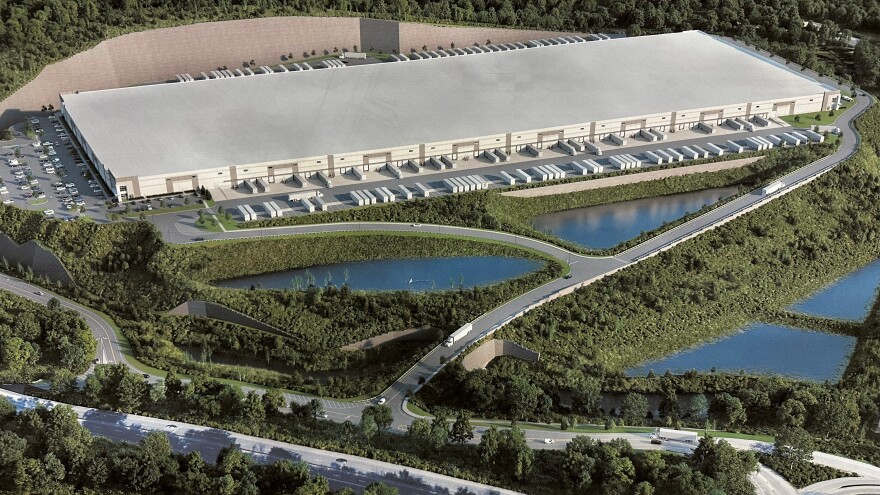
“It does not, OK? ... About 98% of the stormwater goes into these two big green detention basins. They flow into the larger detention basin, and it discharges at the very bottom of the new channel. It doesn't go through 99% of the channel.”
Brown said the new channel would be larger than the existing channel for Spring Brook, and with the same flow rate, the risk for flooding would be miniscule.
Touching on Brandes’s testimony that 10-year and 100-year storms could cause downstream erosion in the Bushkill Creek, Brown said DEP only requires developers control for a two-year storm.
Brown said according to Brandes’s data, a 10-year storm would only increase the flow rate 0.5%, and for 100-year storms, only 0.3%.
Improvement over existing waterway
Brown later said the new channel would be an improvement over the existing waterway.
“The new channel will be 30- to 70-percent larger and basically have a much greater flow capacity than the existing channel,” Brown said.
"This is totally unscientific. It's unacceptable engineering. No one does this."Licensed professional engineer Frank Brown
He said it was designed to prevent stream erosion during any flow condition, up to and beyond a 100-year storm.
He said the new design also supports wildlife in the stream itself.
Kaplin then asked about plans Brandes had suggested: develop a runoff model similar to the site, install a stream gage to measure flow for one to two years, match the stream rate to the model, then use the gage data to enter the 100-year storm into the data.
Brown said that would be impractical, largely due to the many measurements needed, the cost — $80,000 to $100,000 — and the low chance of getting data from five or 10-year storms.
“You're going to get it for one, two, maybe a three-year storm," he said. "You have to extrapolate that little, up to a 100-year storm. You have to extrapolate 98 years.
"This is totally unscientific. It's unacceptable engineering. No one does this."
'Designed correctly'
Brown wrapped up his testimony in a simple statement addressing each point of contention with Brandes’s testimony.
“Stormwater runoff on the site will not cause downstream erosion at Bushkill," he said. "The two-year storm, as I mentioned over and over again, will be controlled. And Dr. Brandes agreed.
“It receives the same flow as the existing channel. It's 30 percent to 70 percent larger. It has a better freeboard. It's designed so stream erosion will not occur there or in the Bushkill."Licensed professional engineer Frank Brown
“With that, the larger storms are insignificant and will not cause downstream erosion. The new channel is designed correctly and will not flood or erode.
“It receives the same flow as the existing channel. It's 30 percent to 70 percent larger. It has a better freeboard. It's designed so stream erosion will not occur there or in the Bushkill.
"It's designed to produce a natural habitat for fish and aquatic life, and it will eliminate the toxic chemicals that the EPA feels might be entering the Bushkill from the existing channel.”
The hearing is tentatively scheduled to continue Jan. 15.