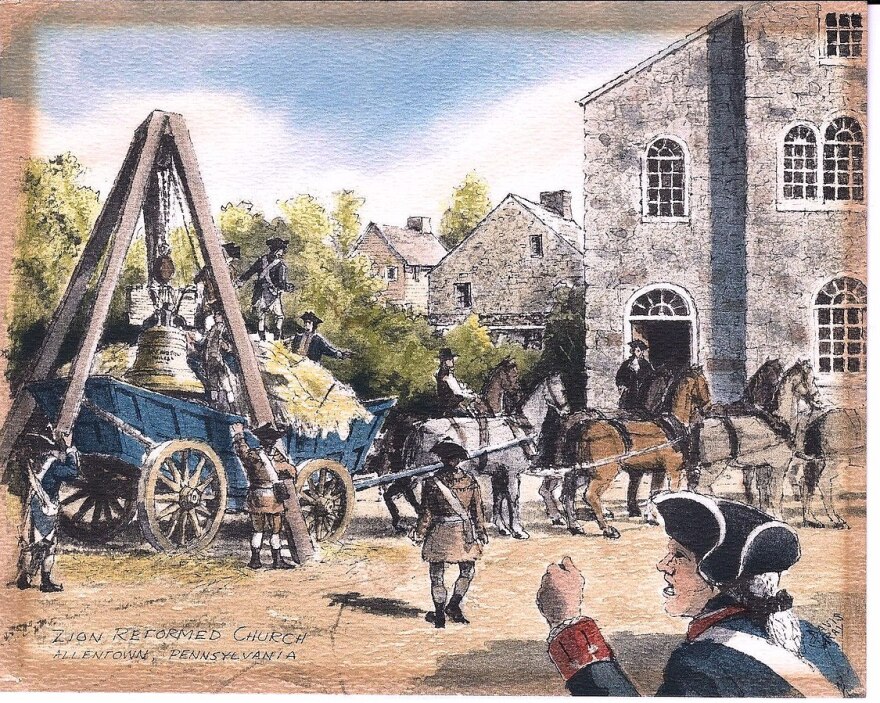
ALLENTOWN, Pa. — America’s symbol of freedom escaped suspected capture in a horse-drawn wagon under the cover of night, hidden beneath straw, hay, manure and/or potato sacks, depending on the version of the lore.
Escorted by a guard of 200 cavalrymen, it traveled from Philadelphia to Quakertown to Bethlehem and, finally, to Allentown on primitive dirt, muddy, rutted and challenging roads.
Paved roads still were 15 years away, making the journey jarringly arduous.
The Colonists' defeat at the Battle of Brandywine Creek in Chester County sparked concerns that British troops may target the Liberty Bell, leading to a decision to hide the bell outside Philadelphia.
But that journey paved the way for its protection from British troops set on melting the Liberty Bell to produce cannons and ammunition.
In September 1777, at the height of the Revolutionary War, British troops defeated Gen. George Washington’s Continental Army troops at the Battle of Brandywine Creek in Chester County.
The defeat sparked concerns that British troops may target the Liberty Bell, leading to a decision to hide the bell outside Philadelphia.
The Supreme Executive Council decided to remove the famous Liberty Bell and 10 other bells to prevent them from falling into enemy hands.
Why Allentown?
The bell, then known as the State House Bell, found its resting place beneath the floorboards of the basement of Zion’s Reformed Church near Sixth and Hamilton streets in Allentown.
By 1778, the British evacuated Philadelphia and the bell was returned to the Philadelphia State House, later known as Independence Hall.
As the nation prepares to celebrate its 250th birthday in 2026, the question lingers: Why Allentown?
"Allentown remains a big part of that history.”Jill Youngkin, chief curator and assistant director of the Lehigh County Historical Society
Why was Allentown, then known as Northampton Towne, chosen as the destination to hide the bell, some 65 treacherous miles from Philadelphia?
“I don’t know 100 percent why,” said Jill Youngkin, chief curator and assistant director of the Lehigh County Historical Society, which houses the Lehigh County Heritage Museum.
“It was probably due to several factors, maybe mostly the size of the church.
"There were other bells that came along from Philadelphia, too. It was a big church, a good place to hide something like the size of the Liberty Bell.
“That the bell was brought to Allentown and later safely returned is a large part of the history of the bell. Allentown remains a big part of that history.”
Replica bell
In 1962, 184 years after the Liberty Bell was safely returned to Philadelphia, the currently named Zion United Church of Christ received a replica bell that became the centerpiece of the Liberty Bell Museum that operated in the old church building until 2023.
In 2023 the church was sold, and the artifacts contained in the Liberty Bell Museum were moved a few blocks away to the Lehigh Valley Heritage Museum at 432 Walnut St.
With one important exception — the replica bell.
Phil Armstrong, who completed his second and final term this month as Lehigh County executive, became involved in the transfer of historic artifacts from the museum in the church basement to the heritage museum.
"When that whole thing was going on between the church and the museum, I stepped up and tried to negotiate moving the artifacts (to the heritage museum) down the street," Armstrong said.
"But I learned the replica bell couldn't be moved for two reasons — the bell is owned by the state and can't be moved without its approval, and the bell is also too big to get out of the church. They say that part of the church was built around the bell."
While the original bell remains in Philadelphia, the Lehigh Valley has a strong connection, featuring its own 1769 church bell rung for the Declaration of Independence, with plans for another replica bell to commemorate America's 250th birthday.
A new, permanent bell is being cast in Pennsylvania and will be placed outside the church where the actual Liberty Bell was hidden.
The 1,500-pound bronze replica bell will cost $250,000 and is funded by the Allentown Neighborhood Improvement Zone Development Authority ($100,000), City Center Investment Corp. ($50,000), PPL ($25,000) and and private donors ($75,000).
"As a former history teacher, I saw anything that draws people back to our history is a good thing," Armstrong said. "That's true especially today when people should remember our founding fathers."
The full-scale replica bell that remains in the church basement was cast in 1950 by Fonderie Paccard, a French foundry, and presented to Pennsylvania.
The thousands of visitors to the museum in the church basement felt a tangible sense of national pride in the presence of the replica bell, said the Rev. Dr. Gregory James Edwards, founder and senior pastor of Resurrected Life Community Church, United Church of Christ — now owners of the old church building between Sixth and Seventh streets on Hamilton Street.
The replica from France is still viewable to those lucky enough to have occasion to be in the basement — but it is not open to the general public.
“We used the lower level for a variety of venues and events,” Edwards said of the church. “And it doesn't make a difference the gender or the race; when people see that bell, there is some level of amazement and almost childlike behavior that begins to emerge.
“And I've seen that from middle to older folks — black and white — and men and women. The look on their faces. It’s the gravitas of history, of (the replica bell) being in a place that people can actually inhabit, unlike the (Liberty Bell Center) in Philadelphia, where the actual bell is.
"Here, you can touch it and ring it.”
Even if one cannot see it.
'Like to hear what it sounds like'
Edwards leaned back in his chair in his office at the church and offered a smile, a welcoming preface to the story he was about to share.
In October, the church held its inaugural Jazz Vespers program, a contemporary worship service blending the ancient Christian tradition of evening prayer, or vespers, with live jazz music.
The event creates a spiritual experience focused on improvisation, community and reflection through music, scripture, poetry and prayer.
“Even the sound of the bell has a way of touching people.”The Rev. Dr. Gregory James Edwards, founder and senior pastor of Resurrected Life Community Church, United Church of Christ
“We had a couple hundred people here,” Edwards said. “And we had a reception in the lower level, where the replica bell is.
“After the vespers program, we walked downstairs. One of our guests was Matthew Whitaker, a guest artist, a jazz pianist, a young Black brother, 24 years old.
"He’s blind and was the first blind graduate of the Juilliard School of Music.”
Edwards said he, Whitaker and his bandmates approached the replica bell. The pastor recalled in detail the looks on the faces of the mostly 20-something Black and Latino musicians as they looked at the bell.
Despite it being a replica, the young men were struck by its representation of history.
“The men began to describe the bell to Matthew, who is blind since birth,” Edwards said. “Then one of them asked, ‘Can I ring it? I’d like to hear what it sounds like.’
“And as one of the men rang it, Matthew, automatically because he’s got perfect pitch, said, ‘Oh yeah, E Minor!’
“Even the sound of the bell has a way of touching people.”
New bell
The celebration of the Liberty Bell and its connection to the nation’s founding continues with the new six-foot bell that will have a permanent home outside the church.
“It will include an inscription including Allentown’s place of America’s 250 history,” said Sen. Nick Miller, D-Lehigh/Northampton. “It’s going to be visible to the people driving by and walking by and celebrating our history.
“It’ll be kind of a mini-historical moment in downtown Allentown.”